Future of Farming in Kenya: The Smart Agriculture Revolution
By Shahidi TV • 2026 • Agriculture & Innovation Desk
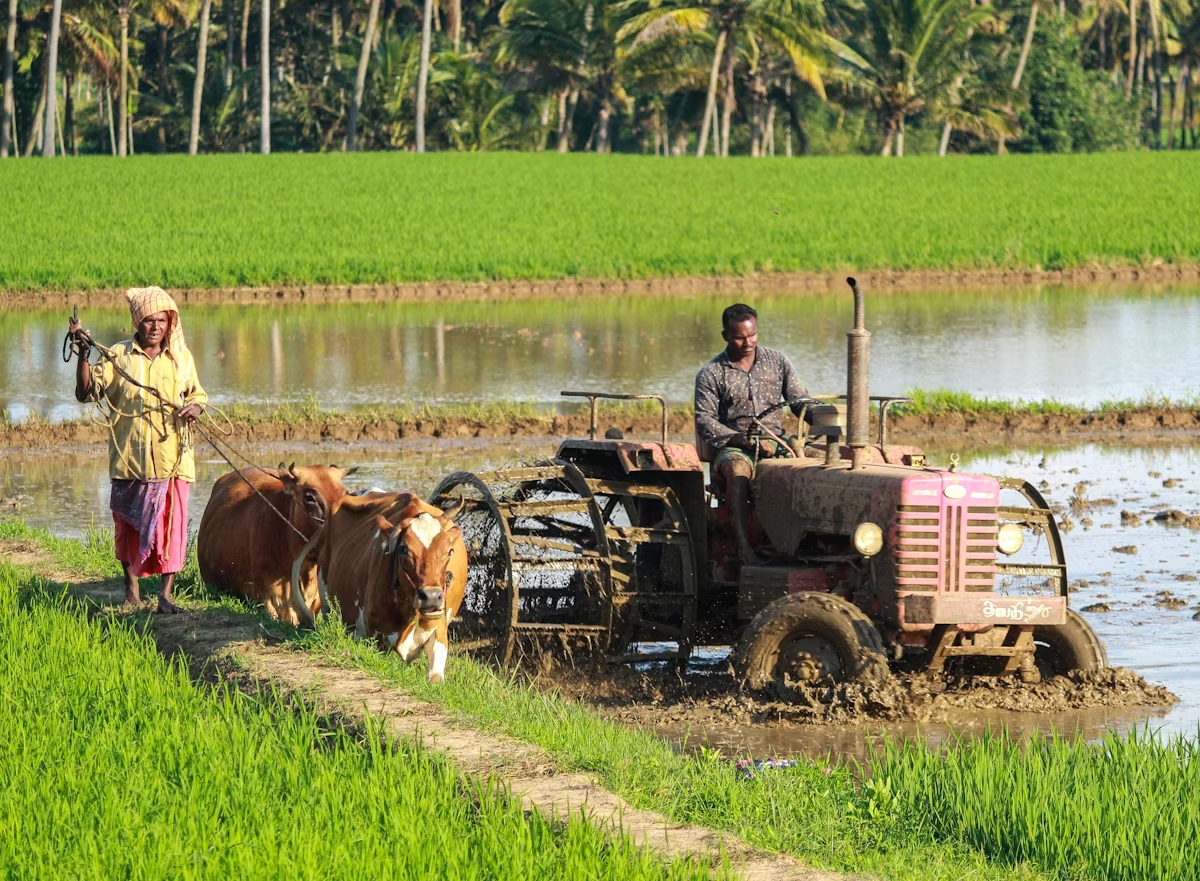
From the fertile slopes of Mount Kenya to the sun-baked plains of Kajiado, a technological transformation is sweeping through Kenyan agriculture—one sensor, one drone, and one mobile application at a time. The farm of tomorrow is being built today, and Kenya is positioning itself at the forefront of this revolution.
Kenya's farmers are no longer simply cultivators of land. Increasingly, they are data analysts, technology adopters, and climate strategists, feeding a growing nation while navigating one of the most complex agricultural environments in the world.
Agriculture has sustained Kenya for generations. It provides food, employment, and economic stability for millions of households. Yet the sector now stands at a critical crossroads. On one side lies the familiar path of traditional farming methods, dependence on rainfall, unpredictable harvests, and increasing climate-related risks. On the other lies a rapidly expanding world of smart technology, precision farming, and data-driven decision-making that is already transforming agricultural productivity.
The challenge is urgent. Kenya's population is expected to nearly double by 2050. Climate change is disrupting rainfall patterns, making droughts and floods more frequent. At the same time, urban expansion is reducing the amount of arable land available per person. Smart agriculture is no longer an optional innovation—it has become a national necessity.
"We are in a race between food demand and farming capacity," says Dr. Samuel Odhiambo, an agricultural policy advisor at the Kenya Agricultural and Livestock Research Organisation (KALRO). "Technology is the only way we close that gap without destroying the land in the process."
One of the most significant innovations transforming Kenyan agriculture is smart water management. Water scarcity remains the greatest challenge facing farmers, with more than 80 percent of the country classified as arid or semi-arid land. Even regions that traditionally receive reliable rainfall are experiencing increasing unpredictability.
Rather than relying solely on larger irrigation systems, farmers are embracing smarter solutions. Soil moisture sensors placed beneath the surface monitor water levels around plant roots and communicate directly with automated irrigation systems. Weather stations provide hyperlocal forecasts that help farmers adjust watering schedules before rain arrives. Satellite technology tracks moisture loss across entire landscapes, helping both farmers and water managers use resources more efficiently.
In Mwea, Kenya's leading rice-producing region, sensor-driven water management systems have significantly reduced water wastage while maintaining strong yields. In Taveta, precision irrigation is enabling large-scale horticulture farms to produce vegetables consistently despite drought conditions.
Machakos farmer Robert Mutiso says technology has transformed his farming operation. By monitoring soil moisture at multiple depths, he now irrigates based on data rather than assumptions.
"I use 50 percent less water and my tomatoes are more uniform than ever before," he explains. "Buyers pay me a premium because of the consistency."
For farmers unable to afford advanced systems, affordable moisture-measuring devices are being distributed through cooperatives, helping even small-scale producers make better irrigation decisions.
Technology is also taking agriculture into the skies. A decade ago, assessing crop health across a large farm required days of physical inspection. Today, drones equipped with multispectral cameras can survey dozens of acres in under half an hour.
The resulting images reveal nutrient deficiencies, water stress, pest infestations, and disease outbreaks long before symptoms become visible to the naked eye. Early detection can dramatically reduce crop losses, particularly from destructive pests such as fall armyworm, which has affected maize production across East Africa.
Drone-based monitoring systems are being piloted in Kenya's major maize-growing regions, providing farmers with real-time information about emerging threats. At the same time, precision spraying drones are helping large farms reduce fertilizer and pesticide use while improving effectiveness.
Lilian Chebet, who manages a 300-acre mixed farm in Uasin Gishu County, admits she was initially skeptical.
"When I first saw a drone demonstration, I thought it was a toy for wealthy farmers," she says. "Two seasons later, I leased drone services and discovered a fungal infection that I had completely missed. Treating it early saved me hundreds of thousands of shillings."
Artificial intelligence is creating another revolution—one that fits into a farmer's pocket.
Kenya has approximately one agricultural extension officer for every 1,500 farmers, making personalized advice difficult to deliver at scale. AI-powered agricultural platforms are helping bridge this gap by providing expert guidance through smartphones.
Applications such as PlantVillage Nuru can identify crop diseases from a simple photograph, delivering treatment recommendations within seconds. Other platforms provide weather forecasts, market prices, planting advice, farm insurance, and access to agricultural credit.
Technology entrepreneur Wanjiru Kamau believes these platforms succeed because they integrate into tools farmers already use.
"Farmers are already on their phones and communicating through digital channels," she says. "The question is what information reaches them. We are filling those channels with intelligence that improves decisions."
The most advanced systems are moving beyond diagnosis and advisory services into predictive analytics. By combining historical weather data, satellite imagery, soil information, and market trends, these platforms can recommend optimal planting dates, predict disease outbreaks, and even warn farmers about potential market oversupply before crops are planted.
While digital tools are changing open-field farming, controlled-environment agriculture is reshaping food production itself.
Kenya's globally recognized flower industry has long demonstrated the value of controlled growing conditions. Now similar technologies are spreading into food production.
Simple greenhouse structures are helping smallholder farmers protect crops from pests and weather damage while extending growing seasons. More advanced facilities use automated climate control, irrigation, and nutrient delivery systems to produce vegetables and fruits at exceptionally high yields.
Hydroponic farming is gaining popularity among urban entrepreneurs in Nairobi, Mombasa, and Kisumu. By growing crops in nutrient-rich water instead of soil, these systems require significantly less land and water while producing high-quality crops year-round.

Kevin Ochieng, a young entrepreneur operating a hydroponic farm from a converted shipping container in Nairobi, sees farming through a different lens.
"I grow baby spinach, basil, mint, and other premium crops," he says. "I supply restaurants and specialty stores. I don't see myself as a traditional farmer. I run a technology business that happens to produce food."
Yet technology alone cannot secure Kenya's agricultural future. Soil health remains the foundation of all productive farming.
Decades of intensive cultivation, excessive tillage, and overreliance on chemical fertilizers have degraded soils across many farming regions. Studies suggest that soil organic matter has declined significantly over the past four decades, reducing fertility and resilience.
In response, a growing number of farmers are embracing regenerative agriculture. Practices such as minimal tillage, cover cropping, composting, and crop rotation are helping rebuild soil health while reducing input costs.
Researchers are also experimenting with biochar, a charcoal-like material produced from agricultural waste. Early results suggest that biochar can improve water retention, enhance nutrient availability, and permanently store carbon in the soil.
"Healthy soil is a living ecosystem," says Dr. Odhiambo. "When we damage that ecosystem, we undermine farming itself. Regenerative agriculture is about rebuilding that foundation."
The agricultural transformation extends beyond production. Access to finance and markets remains essential for farmers to benefit fully from new technologies.
Digital lending platforms are using satellite imagery and machine learning to assess farmers' creditworthiness without requiring traditional collateral. Loans are tailored around harvest cycles, reducing financial pressure and improving repayment rates.
Insurance providers are introducing index-based crop insurance products that automatically compensate farmers when rainfall drops below predetermined thresholds. Farmers in drought-prone regions can purchase coverage through mobile phones and receive payouts directly through mobile money platforms.
Meanwhile, digital marketplaces are connecting farmers directly with buyers, processors, and retailers, reducing dependence on middlemen and improving transparency across supply chains.
Perhaps the most encouraging aspect of Kenya's agricultural revolution is who is leading it.
Women, who contribute the majority of agricultural labor in Kenya, are increasingly becoming champions of technology adoption. Cooperative groups across counties such as Meru, Embu, and Nyeri are pooling resources to invest in irrigation systems, digital tools, and precision farming equipment.
At the same time, young Kenyans are returning to agriculture with a fresh perspective. Graduates from agricultural and technology programs are launching agri-tech startups, drone service companies, greenhouse businesses, and digital agricultural platforms.
"I did not become a farmer," says Kevin Ochieng. "I became an agri-entrepreneur. I use technology, understand markets, and think about growth. What I am doing is completely different from what previous generations did."
Looking toward 2030, Kenya has set ambitious goals for agricultural transformation. These include increasing farmer incomes, reducing post-harvest losses, improving food security, and expanding agricultural exports.
Progress is evident, but challenges remain. Millions of farmers in remote regions still lack reliable internet access, digital literacy, and affordable technology. Closing this gap will require investment in rural connectivity, farmer training, research, and supportive policies.
"Technology is only as powerful as the ecosystem around it," Dr. Odhiambo notes. "A drone is useless without someone who knows how to use the data. A mobile application is useless without connectivity. Smart agriculture requires all the pieces to work together."
What is beyond dispute is that the transformation has already begun. In the greenhouses of Kirinyaga, the sensor-equipped farms of Machakos, the drone-monitored wheat fields of Uasin Gishu, and the hydroponic containers of Nairobi, a new agricultural future is emerging.
It is being built by farmers who carry smartphones alongside their jembes, who read weather data alongside cloud patterns, and who understand that feeding the future requires combining the wisdom of the past with the technologies of tomorrow.
The future of farming in Kenya is no longer a distant vision. It is already taking root.