
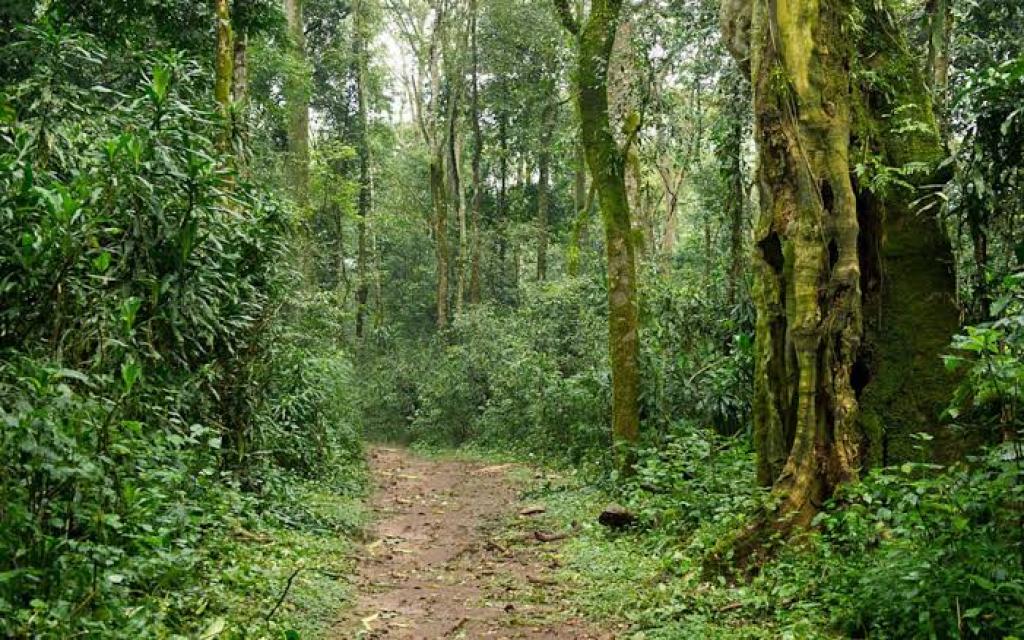
Leaders and conservationists marked World Rainforest Day at Kakamega Forest with renewed calls for restoration, community-led conservation, and urgent action against the invasive Cuscuta parasite threatening Kenya’s only tropical rainforest.
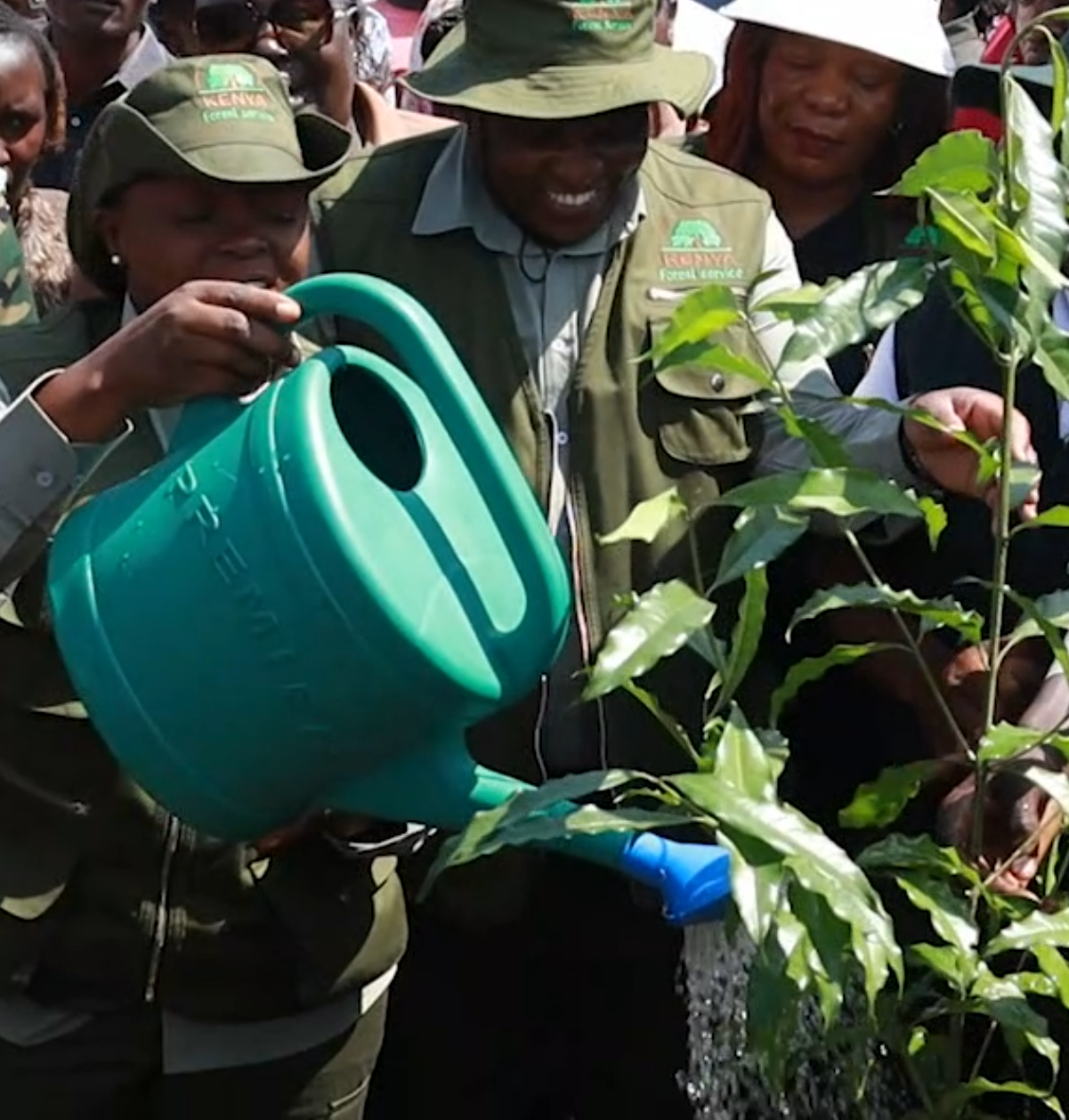
Environment Cabinet Secretary Deborah Barasa plants a tree at Kakamega Forest during the commemoration of World Rainforest Day on June 22, 2026. PHOTO BY VIOLET AUMA
Long before the speeches, before the seedlings, before the dignitaries converged at Lianungo to mark World Rainforest Day 2026, Kakamega Forest had already made its own argument for survival.
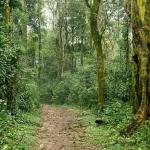
It made it in the hush beneath towering trees, in the damp smell of ancient earth, in the flicker of butterflies beneath a darkening canopy, and in the invisible labour of roots holding together a living world.
This forest is not merely a collection of trees somewhere in western Kenya. It is the country’s only tropical rainforest, the last Kenyan remnant of the great Guineo-Congolian forest system that stretches deep into Central Africa. It is a relic of ecological memory, a breathing archive of biodiversity, and one of the most important natural sanctuaries Kenya still possesses.
On Monday June 22, 2026, that inheritance became the setting for a fresh national plea. Cabinet Secretary for Environment, Climate Change and Forestry Dr Deborah Mulongo Barasa, Kenya’s representative to the United Nations Environment Programme (UNEP), Dr Idah Odinga, and Masinde Muliro University of Science and Technology Vice Chancellor Prof Solomon Shibairo joined other leaders, conservationists and community members inside the forest to commemorate World Rainforest Day under this year’s theme, “The Forest Within.”
It was a fitting theme for a gathering held inside one of Kenya’s oldest and most ecologically significant landscapes, a place whose fate is inseparable from the fate of the people, rivers, farms and communities that depend on it.
For residents of Kakamega, it is more than a forest reserve. It is a climate regulator, a water tower, a refuge for rare species and a reminder of what remains when a nation has not entirely severed its ties with the natural world. It is home to birds, butterflies, medicinal plants and indigenous tree species found in few other parts of the country, including the famed mukombero vine, whose roots are prized for their medicinal value and hawked in towns as far as Nairobi.
Its streams and rivers feed wider ecosystems, linking the forest floor to lives far beyond its boundaries. Yet it is also a wounded forest, an ecosystem carrying the scars of encroachment, degradation and ecological strain in a warming world.
That tension — between wonder and warning, beauty and vulnerability — hung over the event all day. Standing beneath the canopy, CS Barasa gave that tension a language both urgent and expansive. Forests, she said, are “not merely landscapes.” They are “the lungs of our planet, the guardians of our climate, and the cradle of life itself.”
In a speech that moved between policy, ecology and parable, the cabinet secretary framed Kakamega as a place where the world’s triple planetary crisis — climate change, biodiversity loss and pollution — is no longer an abstract global phrase, but a lived local reality. The evidence, she suggested, lies all around: in degraded landscapes, in disappearing species, in shrinking water sources and in the growing strain between people and wildlife as natural habitats come under pressure.
“These are not distant statistics,” she said. “They are painful reminders that when we harm the forest, we ultimately harm ourselves.”
It was one of the most arresting lines of the day because it collapsed the false distance between environmental destruction and human suffering. Forest loss is often discussed in scientific reports, donor documents and policy forums, but in Kakamega it takes a more intimate form: a threatened water source, a disappearing medicinal plant, a weakened ecosystem, a community left more exposed to climate shocks than it was before.
Deborah Barasa sought to place that reality within the framework of state action. She pointed to a raft of policy instruments; among them the National Forest Policy 2023, the National Landscape and Ecosystem Restoration Strategy 2023–2032, the National Agroforestry Strategy, the National Climate Change Policy and Act, and the Kenya National Wood Sector Vision 2050, as proof that the country has begun to build the architecture for long-term restoration. These, she said, are “not mere documents” but “our covenant with future generations.”
Yet it was not policy language alone that gave her speech weight. At its most memorable, the environment CS turned to the image of a seed buried in darkness.
"A seed," she said, "rests unseen in the soil before it sends roots downward and eventually rises into a tree." And a forest, in turn, begins not with grandeur, but with that hidden beginning — a single act of patience, resilience and faith.
The metaphor was simple, but it worked. It transformed tree planting from a government directive into a lesson about restoration itself: that every forest begins small, vulnerable and almost invisible, and that the work of rebuilding damaged ecosystems requires endurance long before it yields spectacle.
As CS Deborah Barasa gave the day its policy urgency, Dr Idah Odinga gave it a moral centre grounded in people. Addressing the gathering as Kenya’s representative to UNEP, Mrs. Odinga described Kakamega forest as one of the country’s most treasured ecosystems and one whose significance reaches far beyond its green boundaries. Rainforests, she noted, regulate climate, protect water resources, conserve biodiversity and sustain livelihoods. But the strength of her remarks lay not only in what she said about forests. It lay in where she located the responsibility for saving them.
“Conservation begins at the community level,” she said, acknowledging the role local communities have played in sustaining the rainforest through tree-growing initiatives, sustainable livelihoods and day-to-day stewardship of forest resources.
That recognition matters. In a country where climate policy is often articulated from podiums and offices, Idah Odinga’s remarks returned the conservation debate to the people who live closest to the forest and often bear the greatest cost of its decline. The continued survival of Kakamega forest, she argued, owes much to the communities that have protected it not through grand declarations, but through steady acts of care, restraint and custodianship.
She also turned the spotlight to schools and young people, praising learners, teachers and environmental clubs for using nurseries, restoration projects and environmental education programmes to cultivate a culture of stewardship among the next generation. If climate change threatens to become the inheritance of today’s children, then the defence of forests, in her telling, must become part of their inheritance too.
Her intervention also lent a human face to the government’s 15-billion-tree agenda, reminding the country that such a target will only become meaningful if it is translated into local ownership. Tree-planting campaigns may be announced in Nairobi, but forests survive through community participation, youth engagement and the quiet discipline of people willing to nurture what they may never personally profit from.
While the speeches laid out the moral and policy case for restoration, MMUST brought the language of action. In remarks delivered during the event, Vice Chancellor Prof Solomon Shibairo said Masinde Muliro University of Science and Technology had formally adopted 10 hectares within Kakamega Forest for intensive restoration using indigenous tree species.
In a region where public institutions are often accused of speaking more about climate change than acting on it, the commitment gave the day something tangible — land, numbers and a measurable restoration footprint.
Shibairo said the university’s environmental work now stretches beyond Kakamega. In the Mt Elgon ecosystem, MMUST has adopted the Chemorit River water source conservation project, using bamboo afforestation to help protect catchment areas and riverine biodiversity.
Through collaborations with government agencies, development partners, financial institutions and community groups, the university says it has mobilised stakeholders to plant more than 200,000 tree seedlings across Kenya, from Kakamega and Mt Elgon to Narok and the Coastal region. During the current financial year, the institution says it has already surpassed its annual tree-planting target, and on Monday it added 1,000 more seedlings to Kakamega Forest.
Those details mattered because they grounded the day’s rhetoric in something measurable. Speeches can summon urgency. Policies can sketch ambition. But restoration acquires credibility when institutions are willing to be counted, to name hectares, to plant indigenous species, to commit to a forest not as a photo opportunity, but as a long-term ecological responsibility.
Still, beneath the hope of the day lay another question — one less visible in ceremonial planting, but impossible to ignore in the wider conversation about forest restoration.
Across parts of Kenya, communities have raised alarm over the spread of Cuscuta, a fast-spreading yellow parasitic vine that many locals grimly refer to as the “devil’s hair.”
Rootless and invasive, it wraps itself around host trees and shrubs and feeds off them, turning living vegetation into its own source of survival and leaving them dry and dead. Its spread raises a difficult but necessary question for a country racing toward a 15-billion-tree target: what becomes of those seedlings if the ecosystems meant to host them are themselves under silent biological attack?
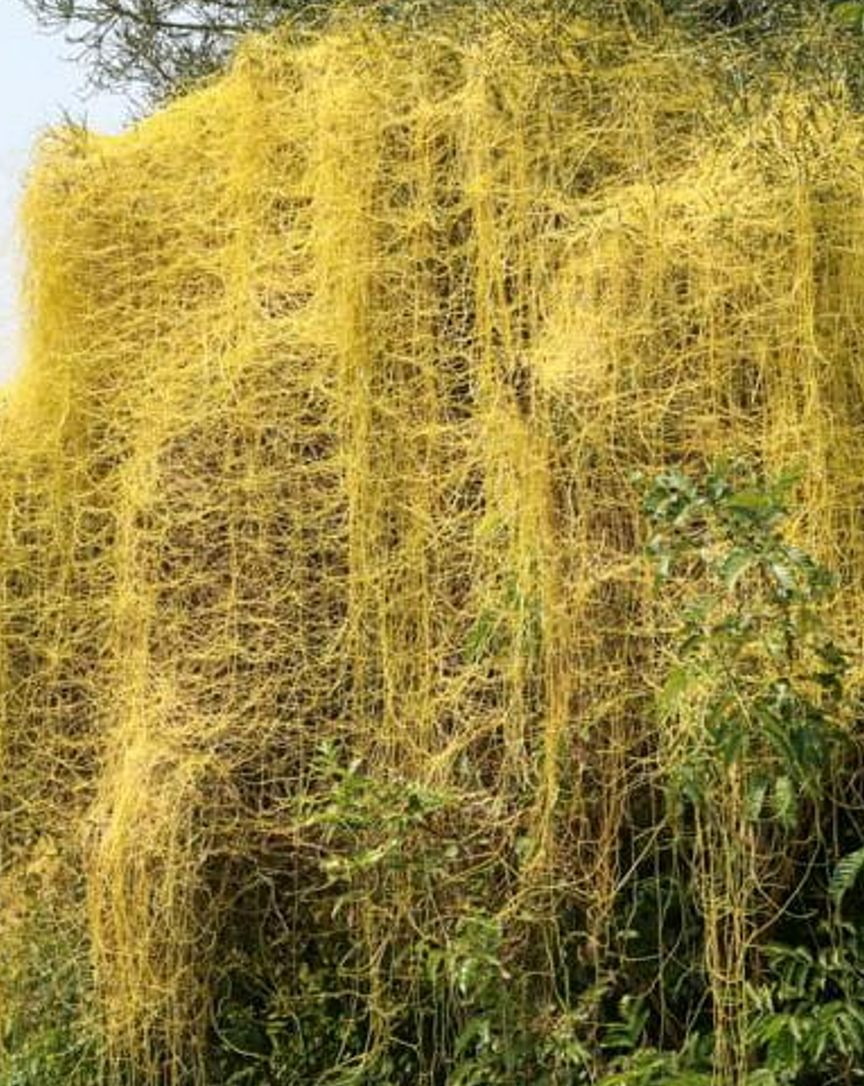
Cuscuta plant (Devil's Hair)
That is not an argument against tree planting. It is an argument for honesty. Restoring forests is not only about the number of seedlings lowered into the soil. It is also about the health of the ecosystems expected to sustain them.
It is about scientific monitoring, indigenous restoration, protection from encroachment, community stewardship, and a serious response to emerging threats — whether from invasive species, parasites, habitat fragmentation or climate stress itself. If those questions remain unanswered, then the country risks measuring success in seedlings planted while ignoring the harder work of keeping forests alive.
That, perhaps, is the deepest lesson Kakamega Forest offered on World Rainforest Day 2026. Not that Kenya lacks ambition. The ambition is visible everywhere — in the language of the 15-billion-tree campaign, in the policy documents cited by the ministry, in the stewardship celebrated by Dr Idah Odinga, and in the institutional commitments announced by MMUST.
The real test is whether that ambition can mature into ecological honesty: whether the country is prepared to protect forests not only through speeches and ceremonies, but through science, law enforcement, indigenous regeneration, long-term monitoring and the humility to understand that saving a rainforest is harder than planting one.
Kakamega forest does not need admiration alone. It needs guardians. It needs a politics that understands a forest is not simply a collection of trees, but a living system of water, shade, soil, medicine, memory, pollinators, birdsong and climate stability. It needs communities empowered to protect what still stands.
It needs institutions willing to turn restoration into measurable work. And it needs a public that understands that when the great trees fall, something larger than timber is lost; the air loses a purifier, streams lose a protector, birds lose a home, soil loses its keeper and a country loses part of its memory.
That is why Monday’s gathering at Kakamega forest's Lianungu block mattered. Not because another environmental event was added to the calendar, nor because another row of seedlings was lowered into the earth, but because for a few hours, inside one of Kenya’s oldest surviving forests, the country was forced to confront a question larger than celebration: If Kakamega forest with all its beauty, all its history and all its ecological significance cannot be protected, then what exactly do Kenya’s climate promises mean?
And if it can be protected through policy, science, community stewardship and relentless restoration, then perhaps the forest still has one more lesson to teach the country beneath its ancient shade: that the future, like a seed, survives only when someone is willing to guard it while it is still small.




Comments (0)