

As the world debates whether children under 16 should be blocked from social media, school leaders in Kenya say the issue is more complex. With CBC increasingly relying on digital learning, educators and parents are calling for supervision, digital safety education, controlled content and stronger parental responsibility instead of blanket restrictions.
By Shahidi Digital Editorial
Kenyan schools are being drawn into a global debate over children, smartphones, social media and artificial intelligence, as more countries consider restricting underage access to digital platforms.
The debate has gained momentum after Australia introduced social media restrictions for children under 16 in December 2025.
But a UNESCO and CLEMI briefing warns that too much hope may be placed in bans, noting that Australian regulators reported no major drop-off in underage social media use, with around 70 percent of the targeted group still remaining on restricted platforms.
The briefing says parents across the world feel overwhelmed and powerless to protect children from harmful content, cyberbullying, addictive platform design and mental health risks in digital environments that often prioritize engagement over children’s safety.
It also warns that artificial intelligence has introduced a new challenge that cannot be contained by a social media ban.
UNESCO and CLEMI are now pushing for a shift from reactive bans to proactive protection measures, arguing that children need critical thinking skills and digital competencies to navigate both social media and AI safely.
Their new guide for parents, expected on June 22, responds to evidence that excessive and poorly supported social media use is linked to cognitive, emotional, physical and social risks among children and adolescents.
Globally, UNESCO data shows that 114 education systems, representing 58 percent of countries, now have national bans on mobile phones in schools, up from 24 percent in June 2023 and 40 percent in early 2025.
But UNESCO does not endorse blanket bans in all circumstances, saying smartphones should only be used in schools where there is clear educational justification and where they do not obstruct learning.
But in Kenya, educators say the answer may not be as simple as banning children from the internet.
At Musango Comprehensive School, Headteacher Wilberforce Wabuti says Kenya’s education system is already moving deeper into digital learning, especially under the Competency-Based Curriculum.
“Kenya is a developing country and this information has infiltrated this generation,” Wabuti says. “Today we are doing a lot of research, and a number of learners are in junior school where almost 90 percent of the curriculum is digitalized.”

Wilberforce Wabuti, Headteacher of Musango Comprehensive School.
According to Wabuti, avoiding the internet completely would be a setback for digital learning in Kenya. He says CBC requires learners to research, present, collaborate and interact with digital content, making it difficult for schools to take a rigid anti-technology position.
He argues that the problem is not technology itself, but lack of guidance on how children should use it.
“Carrying gadgets in schools is outlawed, but the same system gives children homework that needs them to use phones,” he says. “What we need is to educate learners on how and when to use the phones.”
Wabuti says digital tools can improve academic development if used properly. But he warns that when children are left to access the internet without supervision, they are exposed to cyberbullying, online abuse and harmful content.
He says the government should focus on controlling the type of content that reaches learners through digital devices. He recalls the earlier government tablet program, where devices were expected to carry customized educational content, arguing that such controlled learning platforms are safer than leaving children to browse freely.
At Applegate Christian School, Principal Sharon Muhenje says the proposed ban on social media use among children under 16 is welcome only if it is not treated as a total rejection of digital learning.
In her view, digital platforms should be allowed in schools strictly for learning and only under teacher supervision. She says technology helps learners explain their thinking and demonstrate competence, but uncontrolled access is already affecting some children.
Muhenje says some Junior Secondary School learners have joined Instagram groups and online conversations that are affecting their discipline and academic performance.
She says some learners search for harmful information, including content on substances, and later appear absent-minded in class.

Sharon Muhenje, Principal of Applegate Christian School, displays a learner’s artwork.
She adds that the problem becomes worse after school holidays because many children have unrestricted internet access at home.
“At home, they have freedom to access the internet and sites that are not healthy for them,” Muhenje says, adding that some parents buy expensive phones and internet bundles for children but do not regulate what they watch or search online.
She warns that the challenge is no longer limited to mobile phones. Smart TVs also allow children to search and watch content when parents are not monitoring them.
Muhenje says online exposure is also encouraging early relationships among learners, with some children using gadgets to start dating.
In some cases, parents only report that a gadget is missing, and when the school checks, it emerges that the learner had carried it to school despite school rules.
“Banning phones in schools is not enough,” Muhenje says. “Parents need to play their role.”
She says parents must limit phone use, regulate screen time, monitor smart TVs and know which websites their children visit. Schools, she says, can restrict gadgets during learning hours, but they have no control over what happens when children return home.
Pastor Armstrong Lidonde also says parental regulation is critical. He argues that banning digital platforms completely may not be practical because some online content is educational.
“As a parent, you need to regulate what your children are exposed to on their phones,” Lidonde says.
He says parents can use phone-control applications that allow them to monitor what children watch and receive alerts when they access certain content.
He also quotes Proverbs 22:6, saying parents must “train up a child in the way he should go” so that when the child grows older, they do not depart from it.
Kenya’s digital growth shows why the debate is urgent. DataReportal estimates that Kenya had 23.4 million internet users at the end of 2025, with internet penetration at 40.5 percent.
The same report places Kenya’s social media user identities at 18.4 million, equivalent to 31.8 percent of the population.
The Communications Authority of Kenya also reported that by December 2025, mobile data subscriptions had reached 61.9 million, while total mobile phones connected to mobile networks stood at 78.3 million. Smartphone penetration was reported at 92.9 percent.
For Wabuti, these numbers show that Kenya cannot run away from digital learning. He says every school now has an ICT teacher, although many are not fully equipped.
He points to government retooling programs as an important step, but says institutions such as KICD and the Ministry of Education should strengthen digital safety awareness in teaching design.
“Policy-makers should bring awareness rather than only restricting learners,” Wabuti says. “If you restrict African learners, they will want to know why and what they are being restricted from.”
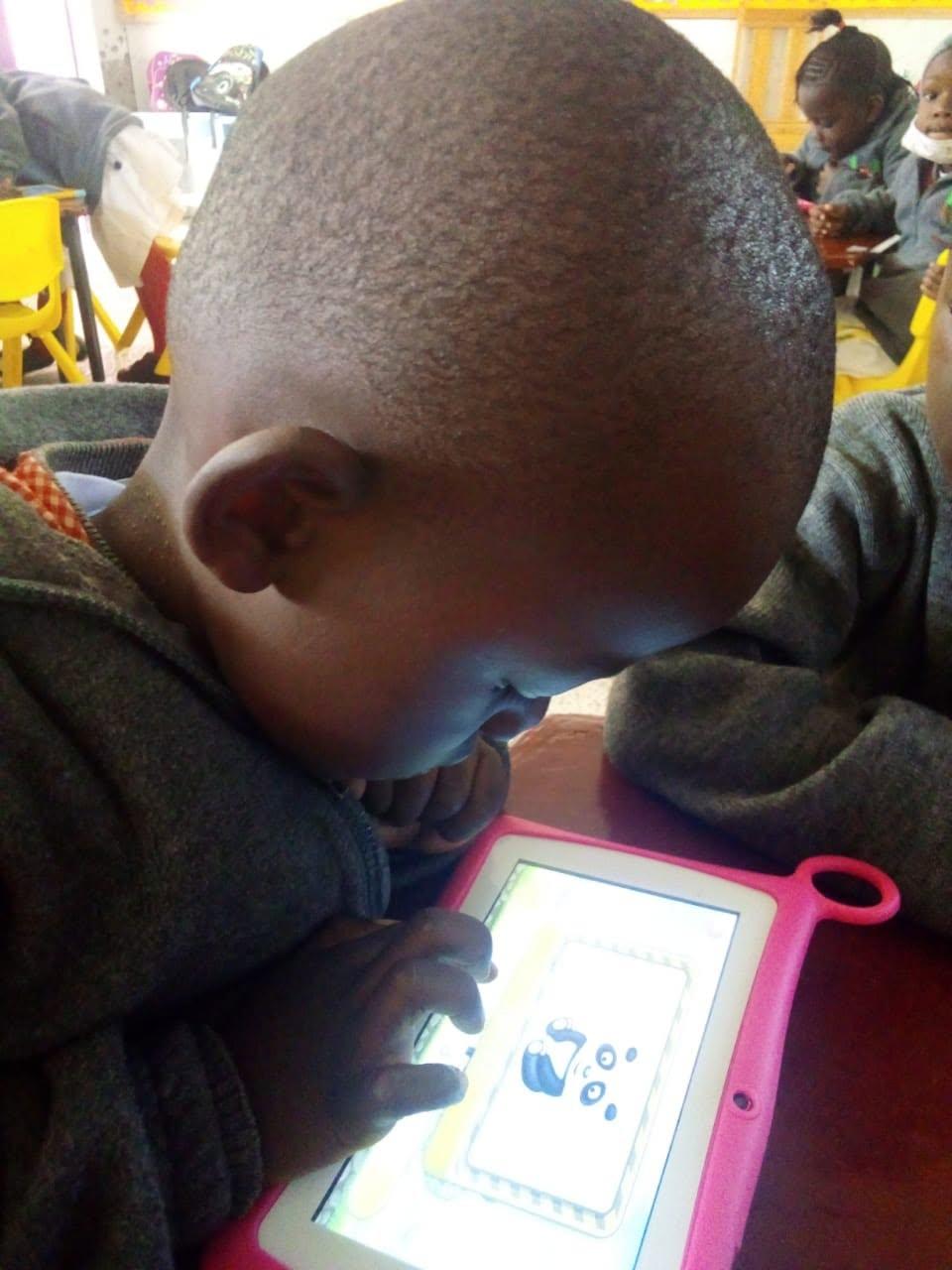
A learner at Applegate Christian School uses a tablet during class.
Muhenje also says the Ministry of Education should support schools with more projectors, laptops and controlled learning devices. She says government-provided devices should have restrictions that block harmful sites and allow access only to educational content.
She says Applegate Christian School allows AI use in group discussions under teacher supervision, but discourages learners from using AI for assignments or homework. The school, she says, does not yet have a formal AI policy.
According to her, AI is both a learning opportunity and a new risk.
“It makes the child not to think and depend on AI,” she says, adding that its use among learners must be closely monitored.
Wabuti agrees that the conversation should shift from fear to guidance. He says children need to be taught digital discipline, online safety and responsible use of phones rather than being pushed into secretive use.
UNESCO and CLEMI are also pushing a similar approach globally. Their new guide for parents argues that children need critical-thinking skills and digital competencies to navigate both social media and AI safely.








Comments (0)