

Vivian Nabwera stepped into her apiary along the bushy edges of Kakamega Forest, donning her thick, canvas bee suit.
A low, rhythmic buzz resonated—one would find it scary but the purr from the honeybees inside wooden hives is sweet music for her. “The bees are not the toughest part of my work,” says Nabwera while walking between a row of beehives, with unusual calmness.
Nabwire, the founder of Myco Enterprises says bee farming is a lucrative venture save for numerous barriers making it hard for women to embrace it full-throttle.
The obstacles include cultural stereotyping and limited access to land, financial constraints, use of pesticides that harm bees and lack of ready market for honey produced among others.
“Women have to overcome many battles in beekeeping before honey reaches the market,” she argues.
Her story mirrors concerns raised by scientists, economists and women leaders in the sector, painting a picture of an industry whose biggest threats are often invisible.
Nabwera started beekeeping in 2019 when she came across an advertisement under the GIZ-funded AgriJobs4Youth programme. It offered technical training in agriculture for young people.
She was lucky to be among the chosen few and packed her belongings ready to embark on training at Bungoma based Sang'alo Institute that would later be elevated to Bungoma National Polytechnic.
Nabwera was expected to foot part of the training cost but that did not dampen her spirit and desire to seek knowledge. "I landed at Sang’alo where my success story in business and agriculture began,” she says.
After completing a course in honey processing, she enrolled at Sigalagala National Polytechnic to pursue a course in beehive construction. It is here she acquired first hand skills on how to construct Kenya Top Bar and Langstroth hives.
“But acquiring skills was only the beginning, after graduating. I sought mentorship from experienced beekeepers at Hive Limited where I attended practical training sessions and eventually bought my first ever hive. It did not take long before it was colonised by bees,” she recounted.
Happy with the achievement, Nabwera borrowed some money and invested in expanding her apiary. Her skills came in-handy as she was able to make her own hives. She transformed her small apiary into a demo farm where young people could frequent to learn.
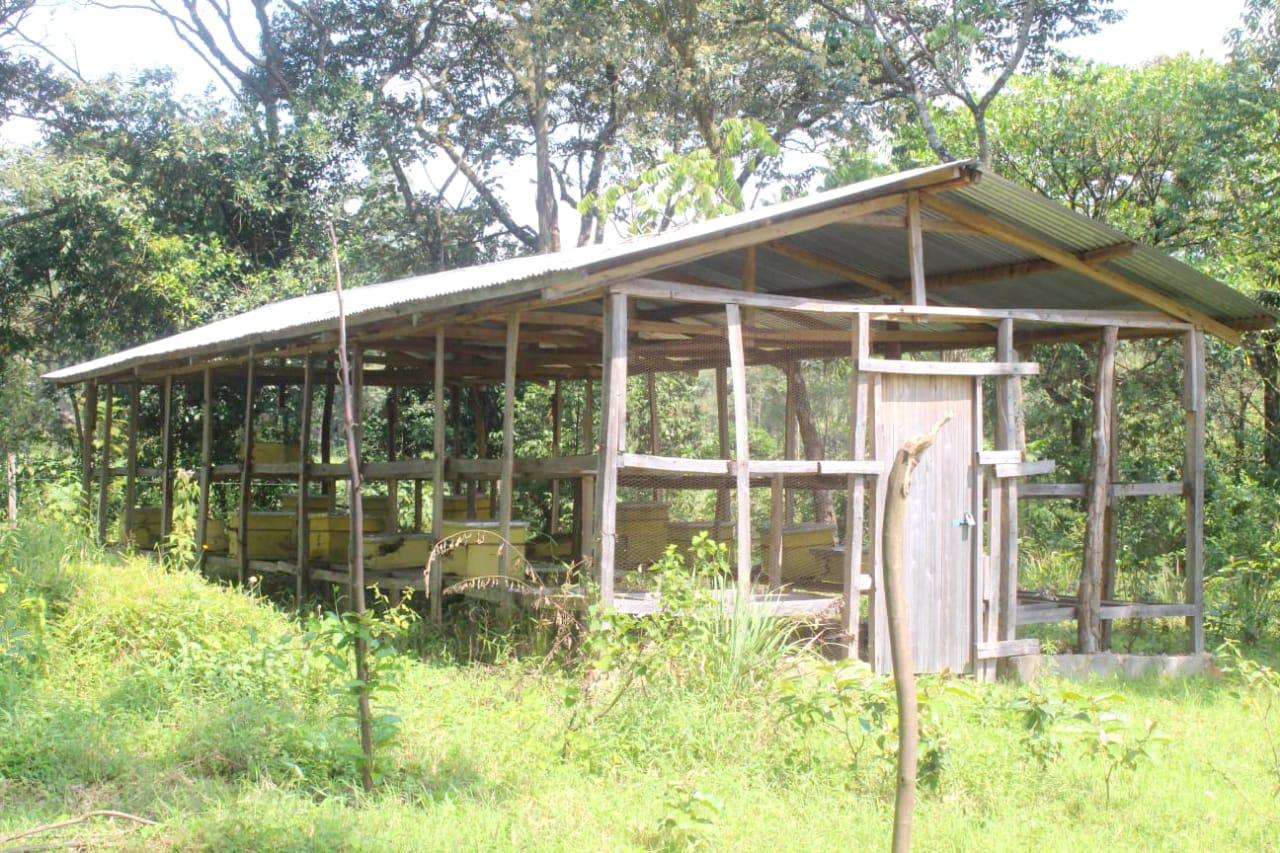
A structure housing beehives at Myco Enterprise's Kakamega farm
It is her determination that would earn her recognition as the best-performing AgriJobs4Youth trainee in the apiculture value chain across the programme's implementation counties.
"I did not want to sleep on the knowledge I had gained but I wanted to use it to improve my life and support other young people," She says.
Despite the milestones she has achieved, Nabwera says succeeding as a woman in beekeeping remains an uphill task. "Many people still believe beekeeping is a man's job," she poses.
"Whenever clients call me, they assume a man will come to help them but whenever I arrive, they are surprised. Some even doubt whether I can handle aggressive bees," adds Nabwera.
That bias, she says, is compounded by limited access to land, an asset owned by men mainly
in many communities across western Kenya where it is almost unheard of for a woman to own land.
Apiculture experts say bees must be kept away from homes and human activity, making access to land even more critical. Women also find it expensive to procure protective gear, modern hives, harvesting equipment and processing facilities.
“It requires significant investment, yet many women struggle to access affordable credit,” says Nabwera.
The struggles are not unique to Kakamega. Speaking during a recent Africa Forward Youth and Innovation Day 2026 conference at the University of Nairobi (UoN), experts urged women and youth to be proactive.
Claire Rono, Director of Mau Forest Heritage Women Cooperative and a representative of Slow Food Kenya, says the two groups must be integrated into every stage of the beekeeping value chain.
She explains that excluding women from production, processing, value addition and marketing weakens the industry itself. "When we leave women out, we lose some of the sector's best marketers and entrepreneurs," she argues.
"Young people are equally important because they bring the innovation that will keep beekeeping relevant in the future, “adds Rono.
She regretted that inadequate financing remains one of the biggest barriers preventing women from participating fully in beekeeping, particularly in forest communities. Beyond social and financial barriers, there lurks the challenge of compromised quality of honey.
Nabwera says many consumers assume honey harvested near Kakamega Forest is naturally pure because bees forage among indigenous trees throughout the year. “Pure honey can easily be compromised through additives,” she warns.
The farmer accuses unscrupulous traders who buy honey from farmers before diluting it with sugar syrup, molasses or water to increase quantity and maximise profits.
By the time the product reaches consumers, she says, genuine honey has already been adulterated.
"We produce pure honey but the problem comes later when middlemen add substances that were never there,” noted Nabwera.
Her concerns extend beyond deliberate adulteration. Unlike livestock, bees cannot be confined to one farm. "They fly wherever they find flowers and you cannot tell them where to feed," she says.
That observation aligns with ongoing scientific research. Dr Gladys Bichanga, a lecturer in the Department of Biochemistry at UoN says bees often forage on crops treated with pesticides before returning to their hives carrying contaminated nectar and pollen.
“Bees wander over wide areas and they forage on farms where pesticides have been applied - they can bring those chemical residues back to the hive," says Dr Bichanga.
She is currently leading a research to develop and optimise protocols for detecting pesticide residues in honey. Her studies show that honey produced in areas with lower agricultural chemical use generally contains fewer contaminants.
Dr Bichanga has encouraged farmers to embrace biological pest control methods instead of relying heavily on synthetic pesticides. "Some of these chemicals affect the bees themselves yet they are our primary pollinators."
For Nabwera, the findings confirm what many beekeepers have observed for years. Healthy bees produce healthy ecosystems, healthier harvests and better-quality honey.
Prof. John Mburu, teaching Agricultural Economics at the UoN argues that Kenya must strengthen the business side of beekeeping if farmers are to realise the true value of their products.
He observes that initiatives such as geographical indications for honey should begin with markets rather than registration alone. "When we create a geographical indication, we should have the market in mind because beekeepers need to know where their honey will be sold and the value they will gain from it."
Prof Mburu believes the honey value chain needs greater digitalisation to improve traceability, market access and consumer confidence.
For Nabwera, those reforms cannot come soon enough. At Myco Enterprises, she is thinking of diversification into pollen, propolis, royal jelly and bee venom production arguing that value addition is the way to go.
“I would wish to embrace value-added bee products such as ginger- and hibiscus-infused honey to squeeze out more profits,” she says.
Nabwera is also determined to continue mentoring young farmers and promoting tree planting around Kakamega Forest because conservation and livelihoods go hand in hand.
Looking back, she says the journey from one bee hive to a growing enterprise has taught her that resilience matters as much as technical skill. “I encourage women to embrace beekeeping."
After a brief pause, Nabwera quips "Without bees there is no food and without food, there is no life."


Comments (0)