

The conviction of former Migori Governor Zacharia Okoth Obado marks the end of one of Kenya's longest-running and most politically sensitive murder trials. But beyond determining the guilt of three men, Thursday's judgment represents a watershed moment in the country's criminal justice system.
It tested whether political influence could withstand the weight of evidence and whether the judiciary could deliver justice in a case that captured national attention for nearly eight years.
On Thursday, Justice Cecilia Githua found Obado, his former personal assistant Michael Oyamo, and former Migori County Clerk Caspal Obiero guilty of murdering Sharon Otieno, a 26-year-old Rongo University student who was seven months pregnant when she was abducted and killed in September 2018.
Delivering her judgment at the High Court in Nairobi, Justice Githua ruled that the prosecution had proved the case beyond reasonable doubt through a compelling chain of circumstantial evidence.
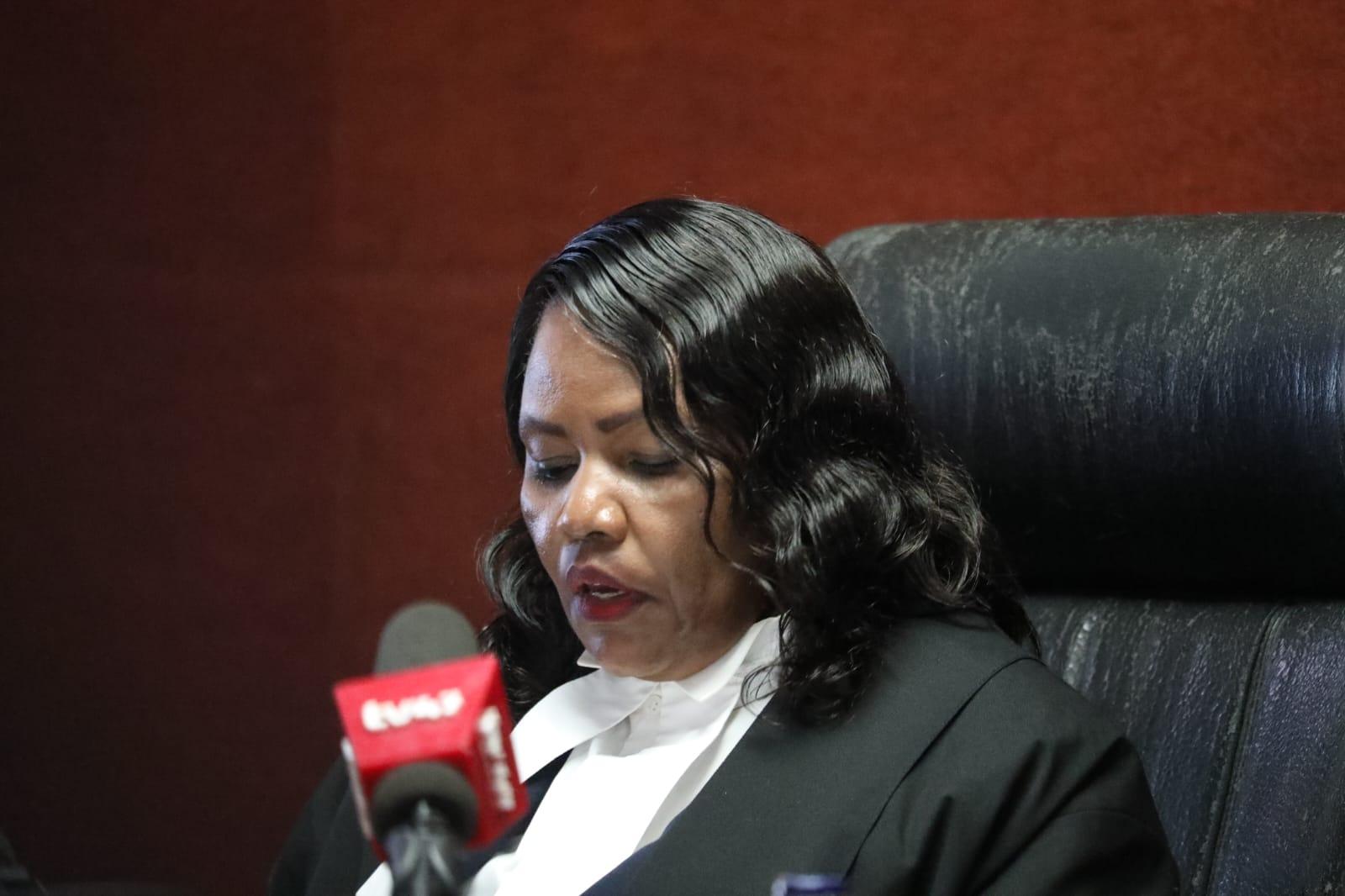
Lady Justice Cecilia Githua delivers the judgment in the murder case of 26-year-old university student Sharon Otieno at the High Court in Nairobi on 23 July 2026, convicting former Migori Governor Zacharia Okoth Obado, Michael Oyamo and Caspal Obiero.
"It is therefore my finding that the prosecution has proved its case against the first, second and third accused persons beyond reasonable doubt. I consequently find each accused person guilty of the offence of murder," Justice Githua ruled.
The judge further held that Obado had a clear motive, saying:
"The first accused had a strong motive to ensure that his illicit relationship was not known by the public, thus making him a beneficiary of the death of the deceased."
Following the conviction, the court cancelled the bonds of all three convicts and ordered that they remain in custody pending sentencing.
More than a murder trial
The Sharon Otieno case evolved into much more than a criminal prosecution. It became a national test of whether Kenya's justice system could hold a powerful politician accountable for a capital offence.
For years, the trial survived repeated adjournments, legal applications and public speculation. Many Kenyans questioned whether the case would ever reach its conclusion.
The guilty verdict challenges the long-held perception that influential politicians can evade accountability through wealth, political connections or prolonged court processes. While justice may have taken nearly eight years, the judgment demonstrates that high-profile cases can still result in convictions when investigators and prosecutors sustain the evidentiary burden.
One of the most significant aspects of Justice Githua's judgment is its reaffirmation of the evidentiary value of circumstantial evidence. There was no eyewitness who saw Sharon being killed. Instead, prosecutors pieced together phone records, witness testimonies, movements of the accused and other forensic evidence to establish a continuous chain leading to the three accused persons.
The ruling reinforces a long-standing principle in Kenyan law: circumstantial evidence can be just as compelling as direct testimony if it forms a complete and unbroken chain that excludes any reasonable alternative explanation. For investigators and prosecutors, the judgment is likely to become an important reference in future complex murder cases.
The murder also exposed the dangerous intersection of gender inequality and political power.
Sharon Otieno was a young university student. Obado was a sitting governor. The imbalance in power between the two became central to public discourse, transforming the case into one of Kenya's most prominent symbols of violence against women.
Women's rights organisations repeatedly cited Sharon's death in campaigns against femicide and gender-based violence, arguing that women involved in relationships with influential men often face unique vulnerabilities. The fact that Sharon was seven months pregnant intensified public outrage and ensured the case remained in the national consciousness.
The Sharon Otieno case also underscored the indispensable role of journalism in exposing wrongdoing and sustaining public accountability. Journalists were present from the moment Sharon disappeared after meeting reporters investigating allegations involving Obado. Their reporting ensured the case remained under public scrutiny through years of court proceedings.
Without sustained media attention, many observers believe public interest could have waned as the trial dragged on. Instead, every hearing, witness testimony and legal application became part of the public record, reinforcing the media's watchdog role in Kenya's democracy.
Justice delayed, but what cost?
Although the convictions have been welcomed by many, the nearly eight-year duration of the trial also exposes persistent weaknesses in Kenya's criminal justice system.
For Sharon's family, justice came after years of emotional anguish. Witnesses were required to testify long after the events in question, while the accused also endured years under the cloud of criminal prosecution. The case illustrates the need for reforms that allow serious criminal matters to be concluded more expeditiously without compromising fairness.
The significance of the ruling extends well beyond the fate of Obado, Oyamo and Obiero. Justice Githua's decision reinforces judicial independence and demonstrates that political office does not confer immunity from prosecution. It also strengthens jurisprudence on the use of circumstantial evidence in murder cases and signals that courts are prepared to convict where the totality of evidence points irresistibly to guilt.
The judgment is expected to influence future prosecutions involving powerful public officials and complex criminal conspiracies.
Long after sentencing and any appeals are concluded, the Sharon Otieno case will remain one of Kenya's defining criminal trials. It exposed the vulnerability of women caught in unequal relationships, tested the resilience of the country's justice institutions and reaffirmed the role of the media in demanding accountability.
For many Kenyans, Thursday's verdict was not merely about convicting three individuals. It was about affirming a constitutional principle—that no one, regardless of political stature or public office, is above the law. Sharon Otieno's name will endure not only as the victim of a brutal crime, but as the centre of a landmark case that reshaped public confidence in the pursuit of justice.


Comments (0)